


“Why don’t you ever go out?”, asks Graham Dashwood in the 2011 John Madden film, The Best Exotic Marigold Hotel.
He asks this of Jean Ainslee, who along with her husband and other British retirees, moved to Jaipur, India, lured by the promise of an affordable but luxurious retirement at the Best Exotic Marigold Hotel. But what they found when they arrived isn’t quite what the brochure promised. The hotel is dilapidated, renovations unfinished. The phones don’t work. Some doors are missing, and the plumbing, is temperamental at best.
And Jean hates all of it — the hotel, the heat, the country. And while the others gradually begin venturing into Jaipur, Jean stays behind at the hotel, miserable.
Which is what makes Graham’s question interesting. Why doesn’t she ever go out?
The obvious answer is that Jean doesn’t go out because she doesn’t like Jaipur.
But as I rewatched the film the other night, I wondered if the movie is showing us something slightly different: She doesn’t like Jaipur because she doesn’t go out.
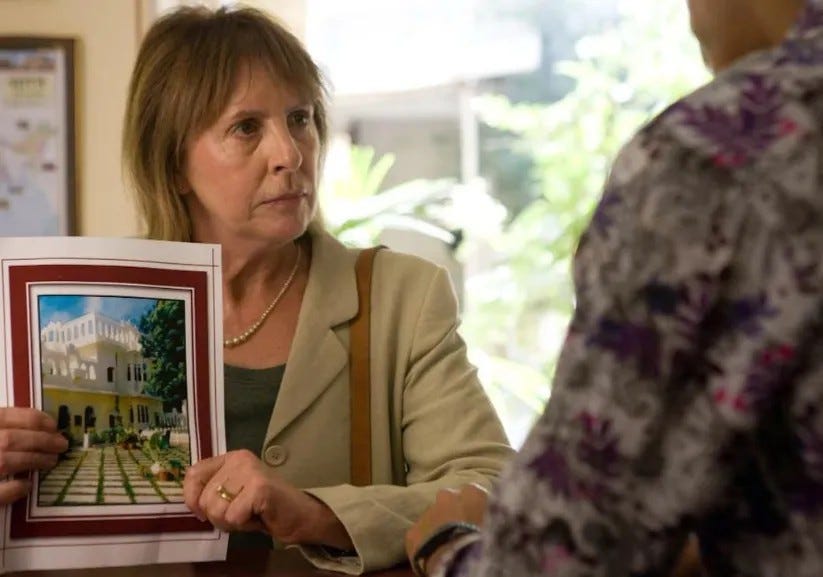
Jean has already decided she’s having a lousy experience, and she can’t imagine that anything outside the walls of the dang hotel might change her mind.
Which becomes a self-fulfilling idea. By staying inside the hotel, she prevents herself from encountering anything different. She avoids seeing anything that might challenge her initial judgement. So she continues disliking Jaipur and their entire experience.
What makes her stance noticeable is that Jean isn’t the only character who arrives at the hotel disappointed. They all do. The Best Exotic Marigold Hotel is objectively not the place they were sold in the brochure.
But they don’t all have the same experience of it.
Evelyn Greenslade, recently widowed and suddenly on her own, begins walking around Jaipur. She talks to people. She looks at things she doesn’t understand and tries to understand them. Madge Hardcastle heads to the local expat clubs and throws herself into the search for a wealthy husband. Jean’s husband, Douglas explores the city on foot (despite her protestations) and immerses himself in the chaotic sounds and colors of local Indian daily life.
None of them has been given a different Jaipur. But their experience of it is entirely different from Jean’s.
• • •
That distinction caught my attention because I think we usually imagine experience working in the other direction. Something happens to us, we take it in, and then we decide what we think about it.
I went there, and I didn’t like it. I tried that, and it wasn’t for me. I met her, and she was annoying.
Experience first, judgment next.
But Jean made me wonder how often those two things happen in reverse. How often do we make an early judgment about something and then continue experiencing it through the judgment that we’ve already made?
Once we’ve decided the conference is boring, do we stop talking to people? Once we’ve decided we don’t like a city, do we stop looking around?
In other words, how much of what we call an experience is the thing itself — and how much of it is the posture we bring to it? 🫢
• • •
Of course, this doesn’t mean our early judgment is always wrong.
Afterall, Jean isn’t wrong about the hotel. It really is dilapidated; the brochure really did misrepresent it. Her initial disappointment is completely reasonable. Sometimes we dislike something because it deserves to be disliked. The restaurant really is terrible, the conference really is boring. Awful is as awful gets.
I think it’s not so much that we make early judgments as it is that we make those judgments permanent. That we don’t allow new experiences to revise whatever we may have been “certain” about.
It’s easy to simply say that Evelyn, and Madge and Douglas just have a more positive, more optimistic attitude than Jean. That may be true, but I don’t think it’s that. I think it’s that they have not stopped gathering new information.
Evelyn does not think, “Oh, everything is great.” She simply decides to go out and have a look around. She allows the place to keep telling her what it is.
• • •
This may be at the heart of what really caught my attention in this movie. Sometimes, we can become too certain about people and things too quickly. And when that happens, we close ourselves off not only to the possibility of discovering we were wrong, but to the possibility of being surprised.
• • •
The first time I heard Graham’s question to Jean, “Why don’t you ever go out?”, I heard it as an invitation. Like, “C’mon, come out. Give Jaipur a chance.”
But on rewatching the movie, I heard something else. Something more like, “How can you already know what’s out there if you haven’t gone to see?”
✴️ I’d love to hear from you:
Has something you were certain about ever surprised you? What happened?
Talk soon,
Lou

Lou Blaser exchanged PowerPoint decks for essays and has yet to regret the trade. She writes Shaping Life, where she follows her curiosity through books, conversations, films, and whatever else refuses to leave her alone.
Thank you for reading. If this essay gave you something to think about, and you’d like to send a little something back, you can buy me a latte. ☕️
Interesting, Lou. You’ve picked one of my all-time favorite movies. And I guess I wasn’t surprised at all by Jean’s unwillingness to go out and experience Jaipur. First we see her obvious snobbishness when she’s in the salon in England, before they leave for India. Then we see her in the airport, when their connecting flight’s been canceled, and she’s saying, “This place is rather more civilized than one expected.” Then she gets to the bottom of the escalator and steps out into the incredible, noisy crowd jostling to get onto the bus and her face falls right into her shoes. That’s when she made up her mind, even before they arrived in Jaipur. She said she wanted something more than a “beige bloody bungalow,” but she really didn’t. In contrast, Evelyn challenges herself, starting with the blog she starts, the job she takes on, and standing up for herself to her son when he’s acting like his father.
I always picture myself as an Evelyn, but I admit I can have rather Jean-ish tendencies at times.
The two “Best Exotic” movies are my all-time favourites. I rewatched each of them often, admiring the expertise of the actors, even in a hit, humid, chaotic country as India.
As I say, live or hate the character? Love the actor!
PS. I found much to compare with my own young life in tense two movies.
I grew up in the Middle East, part of an expat community of people mostly, though not exclusively, from America and Great Britain. Some of us kids learned to play football on the dirt pitch with the local Arab kids, and some of us stayed within the walls of their compound.
It seems age is not a requirement to seclude oneself from the dangers of the Unknown.