


I read a lot.
Reading is one of the organizing activities of my life. There is almost always a book beside me, my Kindle never far away. My To-Be-Read list is so ambitious, the phrase “so many books, so little time” comes to mind.
But a recent experience showed me how oh so easy it apparently is to make me feel insecure as a reader… to make me question whether I’m even good enough. (Don’t worry, I too hear how ridiculous that question is.)
The other day, I read an essay by Petya K. Grady, who writes the popular newsletter A Reading Life.
She was thinking about the kinds of books we read and the hierarchies we sometimes create around them. She described looking for books that were “smart but not exhausting.” She talked about serious readers having an “off-season.” She wondered what someone who mostly reads literary fiction might pick up when they want reading to feel more “effortless and immersive.” Eventually she asked a New York Times Book Review editor which thrillers she would recommend to a literary-fiction reader who wanted “permission to downshift, without it feeling like a lesser choice.”
Downshift.
I got stuck there… I couldn’t get past the word.
Because I read thrillers and mysteries. Police procedurals. Historical fiction. Science fiction. Romance, not a big fan, but I do once in a while. I read whatever catches my attention basically. Sometimes, I want to read beautiful prose or deep stories that touch the heart. But other times, I want to know about the body in the library, and I would very much like the detective to figure it out before I go to bed, thank you very much.
I don’t call any of these my reading “off-season.”
But the longer I read Petya’s essay, the more I felt smaller and somewhat inadequate.
And feeling that way… about something I do every day… really surprised me.
• • •
I’ve always been a reader. Since I was a kid. There was a time in my life when I read almost exclusively non-fiction, particularly the business and management books I spent years studying. Name an important book in that world and there’s a decent chance I’ve read it. I know that territory well and I’m not worried somebody would “find me out.”
But fiction is different.
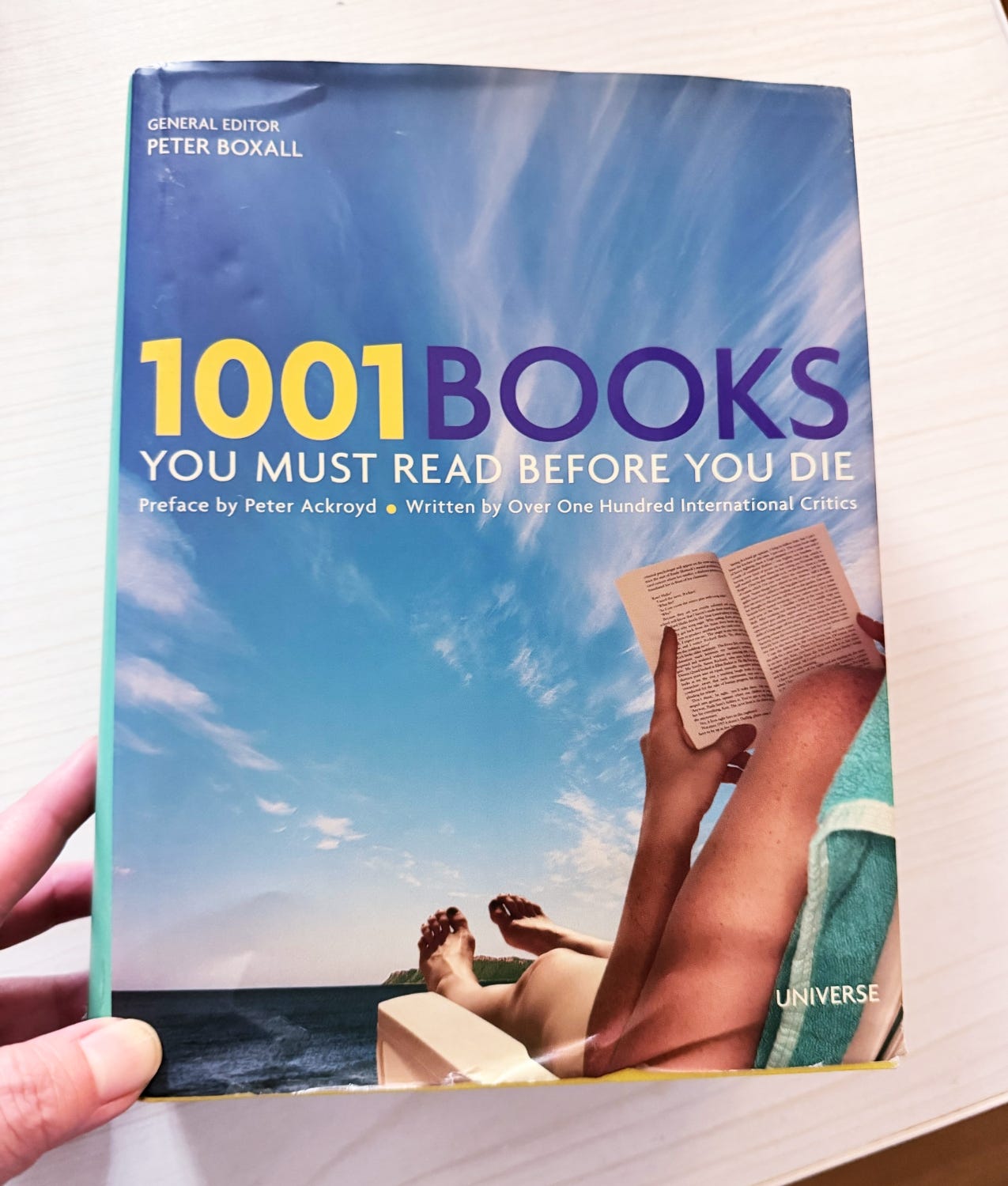
I mean, I admit there are huge holes in my reading. Famous writers I’ve never read. Classics I’ve guiltily avoided. There are books that routinely appear on lists of novels everyone should read before they die… and I apparently intend to meet my maker without having read them. (Although I promised myself, I will read War and Peace.)
Put me in a room of people discussing the Great Works of Literature and I know I will very quickly feel embarrassed. All the hundreds of books I have read will not matter. Only the ones I haven’t will.
I understood this before reading Petya’s piece. Her essay merely pointed it out to me in black and white.
Can someone feel imposter syndrome about being a reader?
What does it mean to be well-read? That’s a phrase I’ve always thought I qualified for. Now, I’m not so sure. 🥺
Because it doesn’t simply mean having read a lot, does it? I mean, a person could conceivably read thousands of books without being considered well-read, while someone else could read fewer but from the correct collection.
So, maybe being well-read isn’t about volume at all. Perhaps it’s about having read the right books.
And there, as they say, is the rub. Because who decided which are the right ones?
• • •
Petya’s essay eventually gets to this. The New York Times editor, Tina Jordan, refuses the hierarchy embedded in Petya’s questions. When asked what thriller might allow a literary-fiction reader to “downshift,” Jordan says she disagrees with the premise. Reading a thriller isn’t necessarily a downshift. The qualities that make a thriller excellent are the same qualities that make other literature excellent: writing, originality, complexity, craft.
And Petya sees it when she rereads her own questions. They “reek of genre-ism,” she writes. She realizes that although she has spent years questioning ideas about serious reading and cultural prestige, some of that hierarchy had somehow seeped into her language: “work harder,” “downshift,” “off-season.”
I appreciated that she caught herself.
Only by then, I was already feeling the imposter syndrome about calling myself a reader.
This isn’t Petya’s doing though. She couldn’t have made me feel inferior as a reader unless some part of me already accepted the terms.
Somewhere along my reading life, I must have absorbed — maybe even bought into — the idea that there is reading and there is serious reading. That some books count toward some intellectual ledger, while others don’t. That reading Dostoevsky says something about the kind of reader you are that reading a spy novel (even if it’s John le Carré’s) does not.
We certainly have language that teaches us this hierarchy. We say “beach read” or “guilty pleasure”. We talk about “important books” and “literary fiction”. Even the phrase “serious reader” carries some shadow. If there are serious readers, that must mean there are unserious ones.
And once those categories exist, it’s an easy slide toward auditing yourself.
Have I read enough classics? Enough Pulitzer Prize winners? Shouldn’t I have read War and Peace by now? What kind of person who spends this much of her life reading hasn’t read that?
• • •
Of course, it’s silly to measure a reading life this way. This is what I tell myself. Surely, if I finished a book that absorbed me completely, gave me a memorable character, made me notice something I hadn’t before, what exactly would be missing from that experience just because the book isn’t on somebody’s list of Great Literature?
This is what I tell myself. And yet, my insecurity remains.
So, I’m asking myself what is this insecurity really about?
Could it be status?
Because there is a difference between wanting to read a book because I’m curious about it and wanting to read a book because of what having read it would allow me to think about myself.
Oof.
I’m not sure I like what that leads me to think about myself as a reader or about my reading life. But I suspect there’s a kernel of truth there for me to tease out.
• • •
I think reading Petya’s essay revealed some of my hidden insecurities, made me ask questions I didn’t want to be asking to be honest. I don’t want to be worrying about whether I’m a sufficiently serious reader. Because I think going there will just pull me away from the thing that made me a reader to begin with: wanting to know what’s inside a book!
Maybe I’ll get to read more of those Great Works I’ve missed. I have a few on my TBR list for sure.
But I’d like to read them because something in them calls to me. Not because I’m trying to fill holes in my reader résumé.
✴️ I’d love to hear from you:
What makes you feel “well-read”… or not?
Talk soon,
Lou

Lou Blaser exchanged PowerPoint decks for essays and has yet to regret the trade. She writes Shaping Life, where she follows her curiosity through books, conversations, films, and whatever else refuses to leave her alone.
Thank you for reading. If you’re enjoying Shaping Life, consider becoming a supporting subscriber or sharing it with someone who might enjoy it too.
I keep reminding myself that today's Great Works started out as yesterday's popular books. Enjoyed this, Lou!
Great read. I felt a bit less of a reader when I was only reading cosy mysteries and books with talking cats so I made an effort to read some nonfiction. I have also tried reading some of Virginia Woolf. Found it stupid and boring. I am halfway through Frankenstein. Finding it depressing and old fashioned. Will I ever read War and Peace? I don’t think so! I have decided that I read for entertainment or I read as just one of my methods for learning. If a book doesn’t qualify for one of these I don’t have to bother with it regardless of what list it is on. I know a lot of things. I don’t think I need to know lots about literature to consider myself educated.