

My reading life
how reading shaped who I became

WAGO is a continuing conversation about who we are becoming and the lives we are unfolding as we get older.
Hello,
If there is one activity that I have always engaged in, from the time I was a kid, it is reading. (How I wish I could also say playing the piano and dancing, but alas, I had stopped doing those, and now want to reclaim them. But that is a story for another time.)
But reading. Yes. Hardy Boys. Nancy Drew. Agatha Christie. My father had an Erle Stanley Gardner lying about, and that introduced me to Perry Mason, and this fantastical idea that I, too, could become a lawyer one day and solve interesting cases, like him and like my father.
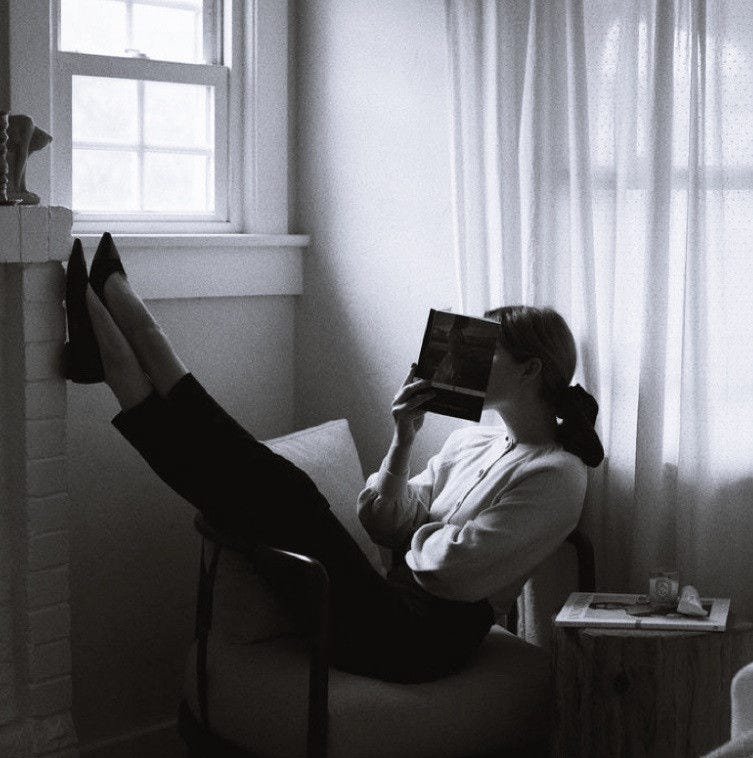
Speaking of my father, I think I got my reading genes from him. I remember him reading all the time, at all hours of the day and night. He had this small home office/library set-up in the house, and I can still recall him sitting behind his desk, surrounded by his books, reading, reading, reading.
Now, studying carried a heftier weight than just reading when I was growing up. This was primarily my mother’s rule. I could study as much as I wanted. Bury my head in my textbooks all day and all night long if it suited. But reading other books, like Nancy Drew? Absolutely not. I should be helping in the kitchen, doing house chores, or practicing my piano lessons.
So, I “hid” my reading. It was my earliest guilty pleasure. I sneaked the other books into my room and read while pretending I was doing homework. It is too funny to think about this now.
• • •
Reading stayed with me through high school, through college, and throughout my adult life. What I was reading, though, changed over time. There was a long period (the career years) when I read mostly non-fiction, mainly management, leadership, and productivity books. When I went back to school for a second degree in IT, technical books got added to the TBR pile.
Reading fiction became even more of a guilty pleasure then, something I would only indulge in while on vacation, lying on the beach, and such. I felt that reading those books was for entertainment, and took me away from the very important task of developing myself so I could climb the ladder. (I had told you before, the career was the center of my universe for a long time, right?)
But slowly, I found my way back to fiction reads in my late 30s, thank goodness for that. Authors like Dennis Lehane, Robert Ludlum, Scott Turow, and Stieg Larsson pulled me back. I fell in love with Anna Quindlen, Anita Shreve (I think I’ve read all her books), and Rosamunde Pilcher. And I found a new appreciation for the classics, which I much enjoy reading as an adult, as compared to when they were assigned readings.
And slowly, slowly, the non-fiction books gave up more and more of their allotted space to novels and short stories.
• • •
I have friends from my younger years who used to be as much a bookworm as I was. But they tell me they’ve stopped reading now. Most of them said their reading slowed down and eventually sputtered to a stop when they got married and had kids.
Although I had been married twice, I never had kids, and so I can’t tell you how child-rearing might have affected my reading life. But I also have friends who continued reading and in fact, passed their love of reading to their children. I’d like to believe that in another timeline, one where I do have kids, that I would fall into this second category.


Outside of required reading for school, though, I’ve never been intentional with my reading. I picked up books I simply felt like reading. I’d go to the bookstore and buy books that caught my attention. Or the ones everybody was talking about, or are on the bestseller’s list. Or books that were recommended to me by friends. Sometimes, watching a movie version drove me to read the book it was based on.
Lately, though, I’ve been interested in reading intentionally. This line from Celeste Nguyen’s essay has stayed with me since I read it the first time:
“I find myself turning this phrase — research as leisure activity — over and over again, especially as I plan out what I want to read this summer, what I want to write, and who I want to be at the end of the season.”
There’s something about being deliberate about what you want to read and immerse yourself in for a period of time that sounds so delicious to my ears. And that this kind of well-considered reading could help me shape my experience and who I might want to be at the end of a given period. How inviting is that?!
Even more directly, following Matthew Long and reading his publication, Beyond the Bookshelf, has inspired me to inject some planning and deliberateness into my reading life. Matthew shared this in one of his essays:
“Each fall, I sit down to plan out my reading for the following year. This is a special day as I think critically about which books to read. Time is finite, and so are the books in one's life. I look carefully through my unread shelves and the list of books I keep close at hand. Where will the new year take me? What will I learn about the world and myself? Who will I become?”
There is one subject I’ve been curious about and wanting to study — The Gilded Age — and I am encouraged by Matthew’s work to come up with a kind of syllabus that would allow me to study this era on my own time. It is such a big topic, though. So, following his suggestion, I’m going to narrow it down to one or two areas to start with or anchor my study in, instead of diving in trying to boil the ocean.
But I’ve also been pulled to read some authors a bit more deeply (also inspired by Matthew’s deep reading of John Steinbeck). Something about immersing myself in one person’s body of work, their world, and their point of view sounds so appealing to me at this stage of my life. I honestly don’t know why this is the case. But rather than psychoanalyzing myself, I’m going to follow my curiosity and stop interrogating. Maybe I’ll be able to articulate this “pull” better once I get into it.
There are three authors that I’d like to do this sort of compendium reading: John Le Carré, Ian McEwan, and Edith Wharton (as her work dovetails with my desire to study the Gilded Age).
But instead of reading all of their work — which I feel is too overwhelming to think about, and also requiring a level of commitment that I’m not sure I have — I’ve selected a few of their work that I feel gives me the core deep dive I’m looking to accomplish.
These are the books on my list:
John Le Carré:
A Perfect Spy
The Spy Who Came In From The Cold
Smiley’s People
Tinker, Tailor, Soldier, Spy (a re-read)
The Night Manager
A Most Wanted Man
Ian McEwan:
Atonement (a re-read)
Enduring Love
Saturday
Amsterdam
On Chesil Beach
Edith Wharton:
The House of Mirth (a re-read)
The Custom of the Country
The Age of Innocence (a re-read)
Twilight Sleep
Ethan Frome (a re-read)
Summer
I don’t know that I will read these books back-to-back. More than likely, I’ll switch from one author to another, and intermix the reading with other books and authors. I’ll have to see and will let you know how it goes.
• • •
These days, I do 95% of my reading on the Kindle, primarily for portability and ease of reading at night. I do miss physical books. I miss the tactile feel, the act of underlining or writing notes on the margins. I miss the feel of flipping pages back and forth, or the act of surreptitiously peeking at the last page. I had amassed a library of books over the years, and when I sold the condo a couple of years ago, it broke my heart when I donated the books to the local library. I keep telling myself I still have a library, albeit digital now.
Reading is such a key part of my life and integral to me being who I am. Strip all the labels, old and new, and being a reader is a nametag I’ll proudly keep. Two of my CliftonStrengths are Intellection and Input, and I’m a card-carrying introvert — I would be totally lost in this world if I were not reading.
Reading has taught me, shaped my thinking, shaped my being, for that matter. Books have allowed me to enter worlds beyond my imagination, walk in other people’s shoes, and see from their eyes. My entire human experience has been made richer and fuller because of books, and I cannot wait to see where my attempt at deliberate immersive reading would lead me.
🏷 Becoming

💬 last word
If there ever was an anthem for appreciating the present moment, finding joy in life's simple moments, and creating memories out of fleeting times when we feel blessed and lucky…
All my best,
Lou Blaser
Lou Blaser writes We’re All Getting Older, a weekly essay series about change, meaning, and the lives we’re unfolding. She also maintains The Filtered, a digital library for reading, learning, and thinking better.
Reading is the one thing I absolutely cannot do every day. Writing, exercise? I love both, but if my day is busy--those slip away. Reading? Never. And there is nothing better than discussing books with other people! Love those conversations.
I admire that you've built a syllabus of books by a select group of authors to dive into -- I don't know that I could do that--I'm too attracted to reading what's getting the latest buzz. That said, I am intentional about what I read because the older I get the fewer years/books I have left.
Books build minds that connect to other minds, stranger’s minds, and find aspects of the self. I have no idea where I’d be without books and wide reading. Slobbering over Tik Toks I guess. Instead I’m on Substack. And all the better for it.